Pfahlgründungen in horizontal geschichteten Bodenprofilen - Impedanzen, seismisches Verhalten und Bewegungen unter
dynamischer Belastung
PILAX21 berechnet im Frequenzbereich unter Verwendung der Methode der dünnen Schichten (Thin Layer Method) auf der Basis der elastischen Theorie –
geeignet für Windows 11 und Linux
Hocheffiziente Software für Baugrunddynamik
PILAX21 bietet eine wissenschaftlich fundierte Analyse der Impedanzen von Pfahlgründungen in horizontal geschichteten Bodenprofilen.
Description of program
1. Purpose
PILAX21 is a computer codes which compute in the frequency domain the impedance and pile forces of pile foundations in horizontally layered soil profiles and their response to vertically propagating seismic waves (Kinematic Interaction). With PILAX21 the horizontal, vertical, rocking and torsional impedances are obtained. The underlying theory of the programs is described in Hartmann [1]. The method utilized combines the capability to consider complex phenomena with effective and fast solution algorithms.
2. Method
The layered soil is assumed to be linear-elastic or visco-elastic. The layers are placed on a rigid or elastic half space. The elastic half space is represented by a number of additional layers whose thickness depend on the frequency. In addition, a simple damping boundary (according to Kuhlemeyer/ Lysmer [4]) or a special damping boundary (according to Kausel [5]) can be applied to the underside.
To derive Green‘s functions in the horizontally layered soil the effective and versatile Thin Layer Method (TLM) in the formulation of Waas [2], [3] is used. The layered continuum is discretized in the vertical direction in a finite element sense. In horizontal direction analytical solutions of the continuum problem are used (Hankel- and Bessel functions).
Generally rigid pile caps are assumed. The calculation of upgoing flexible building structures can be carried out with a general FE-program in a further calculation step outside of PILAX21. In the special case of rigid building structures PILAX21 allows the direct input of dynamic loads and calculates the resulting transfer functions for one or more pile caps or buildings, respectivelly. Calculated impedances or transfer functions implicitly contain the propagation of body waves (compression and shear waves) and surface waves (Rayleigh and Love waves) in the subsoil without interference from reflections at artificial model boundaries. When coupled with building models, the kinematic interaction between the buildings and the ground resulting from the mass inertia is completely recorded.
The linear analyses are performed in the frequency domain. Nonlinear behavior of soil around a pile can be considered by implementing additional springs between pile and soil layers. A secant modulus method can be used for iterative calculation (equivalent linear analysis). The loading may consist of static and dynamic horizontal or vertical forces, predescribed displacements or vertically propagating seismic waves. Pile forces, displacements and accelerations are computed as response. The vertical piles are modeled by beam elements of Timoshenko type. The pile heads may be fixed or pinned at the rigid pile cap. Also several pile caps separated from each other are possible which allows to consider the dynamic interaction of multiple buildings on pile foundations.
In order to reduce the calculation effort in solving the equations two measures are taken:
a) application of flexibility method instead of stiffness method and
b) utilization of simple and double symmetry or cyclic periodicity, respectively, s.a. [1].
The impedance of a pile foundation is defined to be the dynamic stiffness matrix formulated for six degrees of freedom (DOF) in the frequency domain. The matrix elements are complex valued representing amplitudes and phases of harmonic motions at given frequencies. The matrix includes the interaction of the DOFs, the influence of stiffness, damping and mass of the soil and also that of the radiation damping. This means, the energy can be dispersed in the underground by compression and shear-waves and also by surface waves (Rayleigh and Love waves) at the ground level.
In case of NCAP rigid pile caps the stiffness matrix is of DOF = 6 x NCAP including also the interaction terms.
In case of flexible pile caps set NCAP = NR, where NR is the total number of piles.
PILAX21 and related postprograms calculate in detail:
- Impedance matrix of one or more pile foundations with rigid pile cap (formatted results are written on <file>.imp). Matrices can be used as foundation stiffness of FE models in general FE-programs.
- Frequency dependant displacements of pile caps due to harmonic loads, prescribed displacements or seismic exciation (formatted results are written on <file>.cap).
- Frequency dependant displacements and internal forces of piles due to harmonic loads, prescribed displacements or seismic exciation (unformatted or formatted results are written on <file>.dis, <file>.for and <file>.str).
3. Kinematic and inertial interaction for seismic excitation
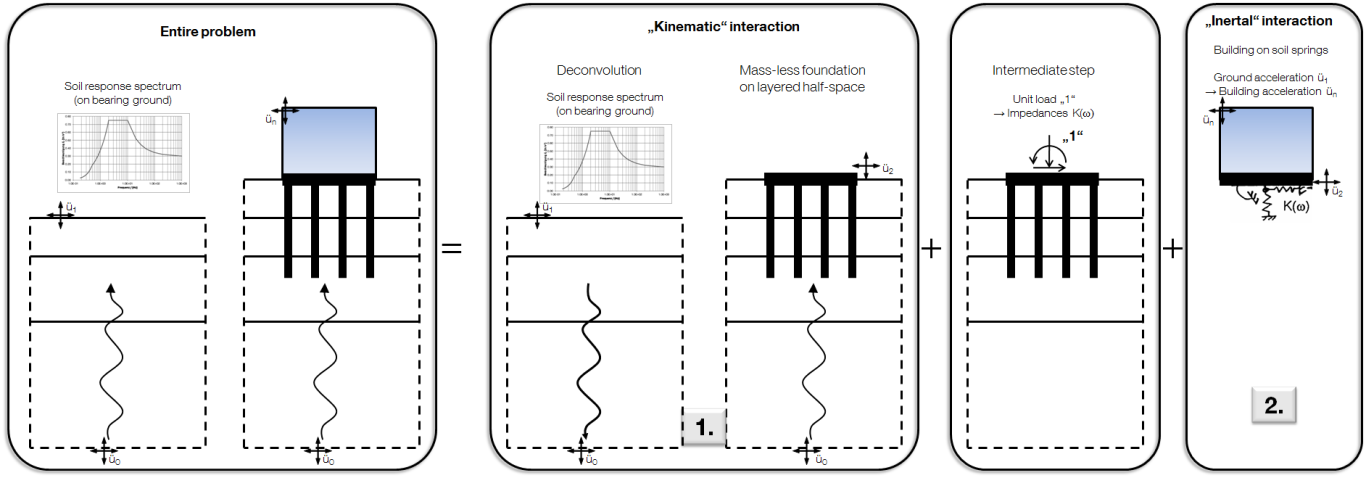
For seismic analyses of buildings on piles the assumption of a rigid pile cap leads to a great simplification of the calculation. The entire problem can be split into two: that of the kinematic and inertial interaction and that of pile foundation and of superstructure, see Fig. 1.
In PILAX21 pile displacements and internal forces due to kinematic and inertial interaction can be calculated.
4. Induced vibrations
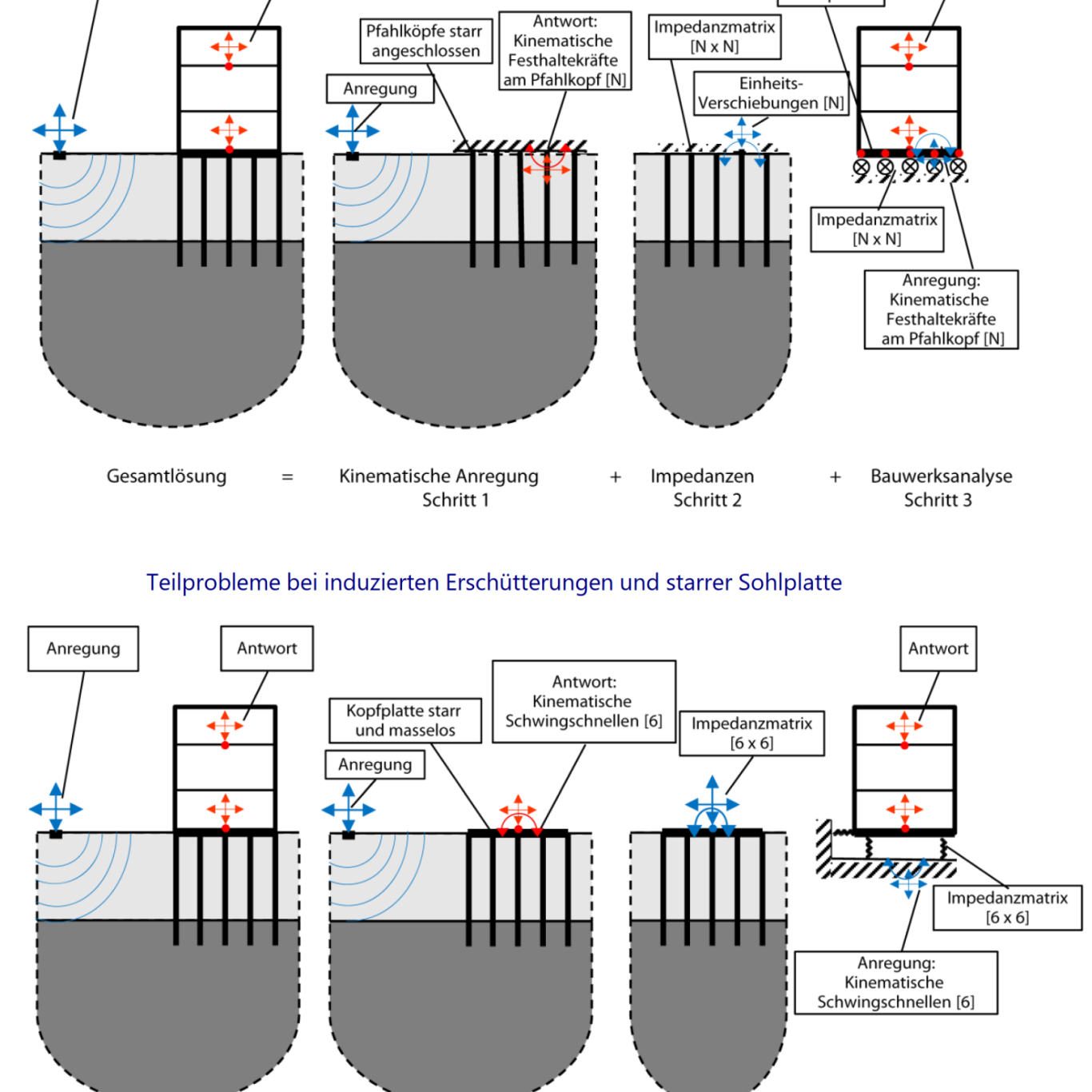
Induced vibrations can be modelled by input of harmonic loads attached at a rigid pile cap (possibly without any real pile) and observation of the response at another pile cap. Also for induced vibrations the assumption of a rigid pile cap leads to a great simplification of the calculation. The entire problem can be split into two: that of the kinematic and inertial interaction and that of pile foundation and of superstructure, see Fig. 2.
Fig. 1: Building on pile foundation subjected to seismic excitation – superposition scheme
Fig. 2: Building on pile foundation subjected to induced vibrations – superposition scheme
for flexible (above) and rigid (below) pile cap
5. Plot options
The geometry of the pile foundations and the layered soil model, the displacements, internal forces and stresses of the piles can be plotted with program PILPLO21.
6. References
[1] Hartmann, H.G. : "Pfahlgruppen in geschichtetem Boden unter horizontaler dynamischer Belastung", Mitteilungen des Instituts für Grundbau, Boden- und Felsmechanik der technischen Hochschule Darmstadt, Heft 26, April 1986
[2] Waas,G. : "Dynamisch belastete Fundamente auf geschichtetem Baugrund",
VDI-Berichte Nr. 381 (1980)
[3] Waas,G. et al. : "Displacement solutions for dynamic loads in transversely-isotropic stratified media", Earthquake Engineering and Structural Dynamics, Vol 13, pgs. 173-193 (1985) , https://doi.org/10.1002/eqe.4290130204
[4] Tabatabaie-Raissi,M. : "The flexible volume method for dynamic soil-structure interaction analysis", Ph.D. Dissertation, University of California, Berkeley (1982)
[5] Seals,S.H. and Kausel,E. : "Dynamic loads in the interior of cross-anisotropic, layered halfspaces", Int. Journal of Solids and Structures (1986)
[6] Rangelow, P., Richter, T., Nincic, V., Kosbab, B., García, J.A., Hartmann, H.G. and
Johansson, J.: Benchmark Study on Impedance Functions of Large Pile Foundations, Transactions, Division III, D3-S7, SMiRT-25, Charlotte, NC, USA, August 4-9, 2019
[7] Hartmann, H.G.: Induzierte Erschütterungen von Bauwerken auf Pfahl- und auf Flachgründungen – Ein Vergleich über numerische Berechnungen, Geotechnik 3/2024, https://doi.org/10.1002/gete.202400015

Wissenschaftliche Genauigkeit
Berechnung der Impedanzen mit der Thin Layer Method auf Basis elastischer Theorie.
Plattformkompatibilität
Läuft sicher und stabil unter Windows 11 und verschiedenen Linux-Distributionen.